Brown, Mushy Leaves After a Freeze Are Not Always Rot
Brown, mushy leaves after a freeze are almost always freeze-killed tissue, not rot, and the difference is readable in the first minute without cutting anything open. Four cues do nearly all the work: where the damage sits on the plant, whether the surface is wet-slick or dry-crisp, how clean the line is between damaged and healthy tissue, and whether the damage keeps growing after the second day. Rot begins at the soil line or at a wound and climbs the stem, goes slick and brown-black, and smells sour. Freeze kill lands on the outermost leaves, usually on one side, feels wet but smells like nothing, and stops.
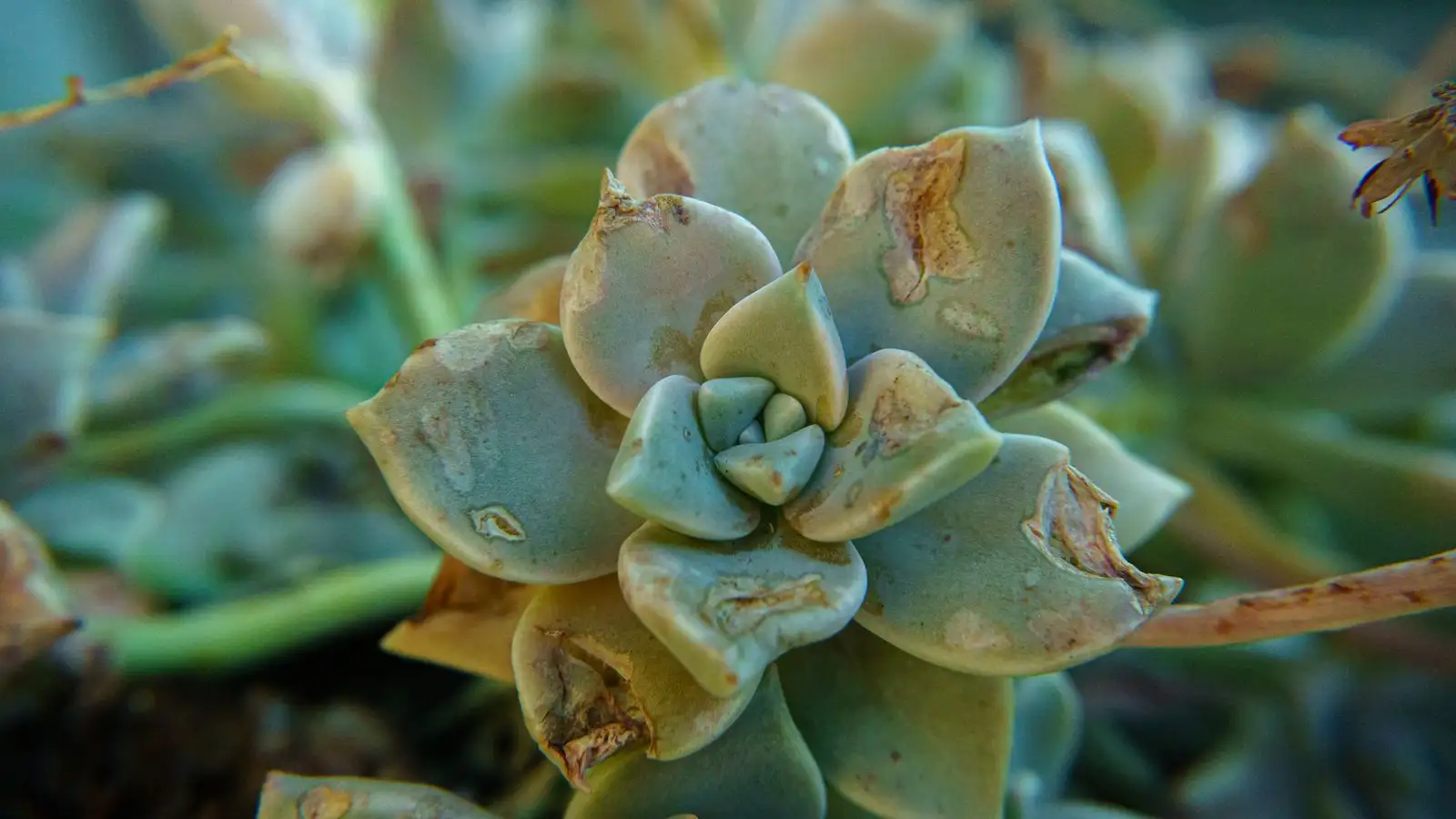
I keep a pencil and a folded paper towel on the counter when I do this, because I want to touch the same leaf twice and I don't want my own damp fingers deciding what I find. The pot goes on the counter with the cold side toward me — the side that sat against the window glass, away from the warm room. That's the side that tells the truth first. When you turn it that way, you're looking at a plant with two different stories written on it, and the job is to figure out which story you're in.
Put two fingers on the middle of an outer leaf — not the tip, the tip always feels wrong. Freeze-killed tissue gives way like a wet paper towel and stays down. It does not spring back. There's a faint glassiness to it too, like the leaf has been soaked from the inside; hold it up to the window and light comes through it in a way the healthy leaves won't allow. Now pinch a leaf on the sheltered side, the one that faced the room. That one fights back. It's leathery. It might be thin and a little soft from weeks of low light, but it pushes against your fingers and recovers its shape. That difference — collapses and stays down versus pushes back — separates cold-killed tissue from tissue that's merely dry or sun-scorched before you've looked at a single color.
The line matters as much as the texture. On freeze damage, the edge between dead and living tissue is usually blurred. There's a translucent halo, a band of pale green where the leaf is on its way out but not there yet. That band is what keeps moving for two or three days after the cold night, and it's why the day-after photo is useless. Sunburn is the opposite. A sunburn scar has a hard border, a line you could trace with a pencil, and it does not cross that line again. If the brown patch has a clean, sharp edge and the tissue inside it is crisp and papery rather than limp, you're looking at old light damage, not a spreading problem.
Then smell it. I mean actually lift the pot and put your nose near the crown, where the leaves meet the stem. Cold-killed tissue is odorless, or at most smells like wet dirt and old leaves. Rot has a smell you'll recognize from the back of a refrigerator — sour, fermented, slightly sweet in a bad way. A leaf that is mushy and gives off nothing is far more likely to be freeze-killed than infected. A leaf that is mushy and smells like that is a different situation entirely.
What the first minute can't tell you
Everything above is a snapshot, and a snapshot taken on the wrong morning will lie to you. Frozen tissue doesn't brown in the cold; it goes glassy and green-brown first, and the real color arrives a day or two later. So I use the first minute to establish a baseline, not a verdict. I don't write anything down, but I look at the same four things again on day two and day three. Freeze damage softens and darkens, then levels off. The leaf dries from the edge inward, turning papery and grey-brown, and the inner leaves stay put. Rot does the opposite. It accelerates, especially in a warm room, and it walks up the stem rather than sitting out on a limb. If the softness has moved closer to the soil line on day three than it was on day one, that isn't frost.
The other honest limitation: the two can stack. A plant that froze and then sat in cold, wet soil for a week can have freeze-killed outer leaves and a crown that's starting to go. You find that by checking two places instead of one — the outer leaves for the cold story, the soil line for the other one. Rot at the soil line shows up as a stem gone dark and slick where it meets the soil, with a soft give when you press. Sometimes the outer leaves are brown and crisped but the crown is perfect, and that's the easy version. Sometimes both cues are present, and the freeze damage turns out to be the smaller of the two problems.
The scar that never needed cutting
The most common mistake I see — and the one I made for years — is treating a healed scar as an active infection. Corky brown patches, hardened edges, a dry scab on the underside of a leaf, a pitted spot where something dropped on it: those are old wounds. They're dry. They don't smell. They have a clean edge and they don't change between visits. Nothing about them calls for a knife. What makes them look alarming is the color, and color is the least reliable cue on this list. Tissue goes brown for a dozen reasons, and most of them are finished.
Run the four cues in order and the scar disqualifies itself: wrong location for rot, wrong texture, clean edge, no movement. Set the pot back down. The freeze damage is the thing to keep an eye on, and even that usually dries into a papery husk on its own. The plant tells you which way it's going. You just have to look at the same place twice.
Educational content only: check with a qualified horticulturist, licensed pesticide applicator, or your local extension office before acting on anything specific.
