Label Rules for Powdery Mildew Fungicide on Succulents
Powdery mildew on a succulent gets treated by the label, not by the brand: choose a product whose active ingredient is listed for powdery mildew and whose label names the kind of plant you're spraying, then follow the rate, interval, and temperature range printed on that specific label, wear the protective equipment it requires, and stop at the seasonal maximum it sets. Sulfur, copper, and chlorothalonil are the three contact fungicides succulent owners most often end up holding, and their burn risks on succulent tissue are different enough that the label on the bottle in your hand matters more than anything said about a product in general.
I keep a magnifier in the drawer with the shears, and it isn't for the plants. It's for the back panel of the bottle. The legal text on a fungicide label is set in type small enough that I've caught myself squinting at a nutrient number and calling it an application rate, which is exactly the kind of mistake that ends with scorched leaves and a wasted bottle. So when I bring a bottle to the counter, the plant comes with it, the light stays on, and I read the whole panel before I open the cap.
Here's the order I read it in, because the order matters more than people expect.
The four lines that decide everything
Active ingredient first. Not the brand name, the active. It'll be listed as a percentage and a chemical name, and that's the thing that determines how the product behaves on a leaf, how long it lingers, and what it can legally be combined with. Everything below that line is a consequence of it. Sulfur. Copper, usually as copper octanoate or one of the copper hydroxides. Chlorothalonil. Those three cover most of what's on a shelf aimed at powdery mildew, and none of them behaves like the other two.
Then the plant list. This is the part people skip and the part that makes a use legal or not. Powdery mildew appearing in the disease list is not permission to spray it on whatever you want. The registered plants are a separate list, and it's frequently narrower, roses and fruit trees and turf and field ornamentals. "Ornamental" is broad enough to cover a potted Echeveria in most cases, but I've stood in a store with a bottle where the wording really didn't clearly reach a windowsill succulent, and when the wording leaves you guessing, that's your answer. It's not on the label, so it's not a use I'm willing to make.
Then the numbers: the rate, the interval between applications, and the maximum number of applications per season. All three are printed on the label and all three are limits, not suggestions. Going above the rate isn't a shortcut to a faster kill. It's the fastest way to burn tissue and lose a plant you've had for years.
And then the temperature and light clause, which is where succulents get hurt. More on that below, because it ties into copper specifically.
Sulfur, copper, chlorothalonil: same job, different ways to go wrong
All three are contact fungicides. That's the single most useful thing to know about them, and it changes how you spray. They don't move through the plant. They sit where the droplet lands. If you miss the underside of a leaf, you've missed the fungus living there, no matter how good the product is. Coverage is the whole game with these, and a light mist over the top of a rosette is close to a wasted application.
Sulfur is the oldest of the three and the one I reach for first on a plant I'm not worried about, partly because it's inexpensive and partly because I know what it looks like when it goes wrong. It's a protectant. It works on contact with the spore and it leaves a residue, which on a blue-leafed succulent is ugly but usually harmless. Heat is the real problem. Sulfur labels carry a temperature ceiling, and I've seen that ceiling anywhere from the mid-eighties upward depending on the formulation, and that number is not decorative. Sulfur plus direct sun plus a hot afternoon is how you get leaf scorch on an otherwise healthy plant.
Copper is the one that catches people. It's effective, it persists, and it leaves visible marks on succulents when the timing is wrong: dark speckling, a bruised look across the leaf, sometimes a hard burn along the margins. Strong sun and high heat make it worse, which is why I never apply copper in the middle of the day or on a plant sitting in a south-facing window with the glass magnifying everything. Copper also doesn't cure an infection already inside the tissue. It protects the surfaces it lands on. Spraying copper at a plant that's half-covered in mildew means you're protecting what's left, not undoing what's there.
There's a second copper caution that has nothing to do with the plant. Copper is highly toxic to aquatic life and to the invertebrates in a fish tank. If your watering routine empties saucers into a sink that drains toward a tank, or if you spray anywhere near an aquarium, handle the runoff like the chemical it is.
Chlorothalonil is broad-spectrum, contact, and by far the least forgiving of the three on paperwork. Its labels carry specific restrictions and a plant list I take literally. It shouldn't go on anything not named on that label, and it shouldn't be used in ways the label doesn't describe. No improvised tank mixes, no "a little extra," no borrowing a rate off a different crop. It's also a strong eye and skin irritant, and it's the reason I keep a separate pair of gloves for it. One more thing: chlorothalonil labels have been revised more than once in recent years, which means a bottle sitting in a garage since who-knows-when may not reflect current restrictions at all. If the label is faded or the product is ancient, I don't try to interpret it. I start over with a fresh bottle and a legible panel.
The thing that doesn't grow back
Here's what I wish someone had told me before my first spray bottle, and it's the piece most label explanations leave out entirely.
A lot of succulents, Echeveria and Pachyphytum and Graptopetalum and the blue Sedums, wear an epicuticular wax coating that gives them that frosted finish. Water alone beads off it. Spray does not. Sulfur, copper, chlorothalonil, even a soapy homemade mix: anything that wets the leaf and dries on it can strip that bloom, and so can the wiping you do afterward to get the residue off. The wax does not regenerate on that leaf. It's gone. That leaf will be a different color than the ones that come after it, permanently.
I still spray those plants when the mildew is bad enough. A stripped leaf is cosmetic; untreated powdery mildew on a stressed succulent is not. But I want to be making that trade on purpose, with the bottle in my hand and the plant list in front of me, rather than discovering it three days later and wondering what I did wrong.
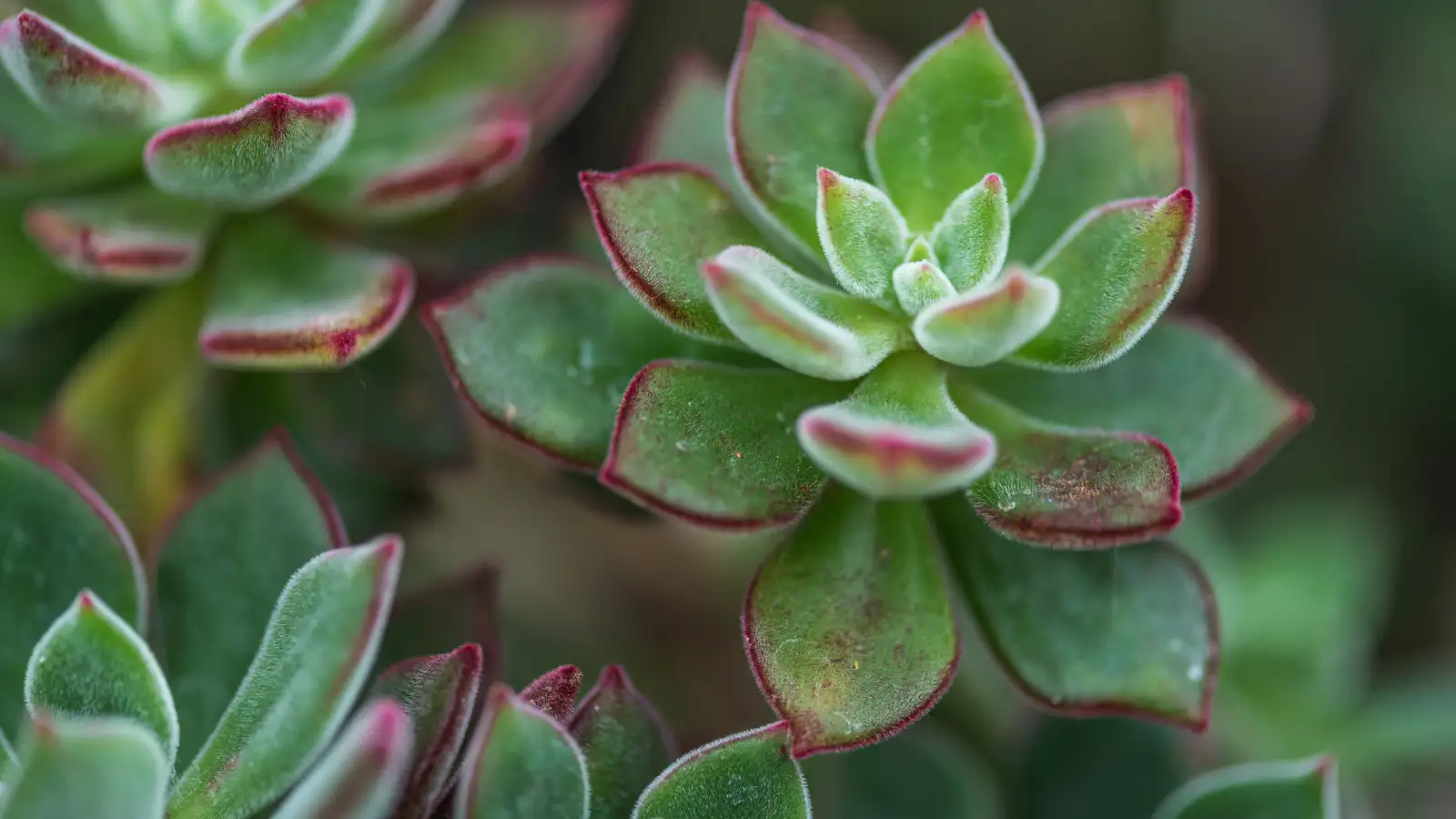
While we're on identification: white fuzz on a succulent is not automatically powdery mildew. If it wipes off in strands and there's an insect at the end of them, it's mealybugs, and no fungicide will touch it. Mildew looks like flour dusted into a patch, usually starting on the undersides and in the crevices between leaves, and it wipes off as a smear.
Gear, timing, and the one leaf you test
The protective equipment section of a label is written for someone spraying a field, and it still applies to me in a kitchen with one plant. Gloves, chemical-resistant, not the thin gardening pair I use for repotting. Eye protection. Long sleeves and pants, not shorts and sandals. For anything I'm misting, a mask. I learned that one the hard way: the first time I sprayed sulfur indoors with the bathroom fan running and a bandana over my face, I could taste it in my throat for an hour afterward. Now it happens outside, or beside an open window with real cross-flow, standing upwind, and I don't lean over the plant while I'm spraying.
Then timing. Evening is the safe window, or a cool cloudy morning. Never in bright sun, never in the heat of the day, and never on a plant that's already dry and heat-stressed, because those are the leaves that burn. If the plant lives in a sunny window, I move it into shade before I spray and leave it there for the rest of the day.
Before any of that, I test on one leaf. Spray a single leaf, mark it with a twist of tape on the pot rim so I don't confuse it with another, and wait a day or two. If it darkens, goes glassy, or scorches at the edges, that tells me what the rest of the plant would have looked like. A whole-plant mistake on a succulent is not something you grow back.
Rotation is a label instruction, not a philosophy
Resistance guidance gets repeated so often it turns into background noise, so let me be precise about where it applies here.
Sulfur, copper, and chlorothalonil are multi-site contact fungicides, the low-resistance-risk category, which is why some of them can be used repeatedly without the fungus developing tolerance the way it does to single-site products. Their labels print a group code on the front panel, and that code is what you rotate by, if you rotate at all. But the more practical reason I alternate isn't resistance. It's that each label caps how many times per season you can use that product, and the caps are lower than people assume. Rotating between two actives with different group codes lets me keep treating a stubborn infection without blowing past either limit.
The limit is what I actually write down. Date, active ingredient, rate used, which plant. There's a strip of tape on the bottle with a running tally on it, because I will not remember in August what I sprayed in May, and I don't want to discover I've hit the seasonal maximum on the one product that was working.
The spray is the small part
Nothing about a fungicide addresses the conditions that produced the mildew in the first place. These spores live in debris. They sit on the fallen leaves in the saucer, on the rim of the pot, in the crevices at the soil surface, in the dead tissue you left on the plant because it was "just a little spot." You can spray a plant perfectly on schedule and watch the mildew return in two weeks because the leaf you pulled off in March is still sitting on the windowsill behind the pot.
So the sequence I actually use is: remove the infected leaves, wipe the rim and the saucer, clear the debris, get air moving around the plant and stop crowding it against its neighbors, and then spray what's left. Then keep it out of the still, humid corner it was in. Chemical treatment on top of bad airflow is a subscription, not a cure.
The last thing, and the label can't give it to you: nothing on that panel knows what your plant has been through this month. A succulent repotted last week, one that's been in a hot car, one sitting in soil that hasn't dried out since spring, that plant is more fragile than the label assumes, and the same spray that would be fine in October can be the thing that finishes it in July. Read the label first. Then look at the plant and decide whether it's in any shape to take what the label is about to give it.
Educational content only: check with a qualified horticulturist, licensed pesticide applicator, or your local extension office before acting on anything specific.

Your Succulent's White Fuzz May Not Be Powdery Mildew
Not every white coating on a succulent is powdery mildew. Use texture, location, and insect presence to tell mildew, mealybugs, salts, and mite webbing apart.