Your Succulent's White Fuzz May Not Be Powdery Mildew
White fuzz on a succulent is only sometimes powdery mildew. More often it is mealybug wax, dried mineral salts from hard water, spider mite webbing, or the plant's own powdery bloom — and texture, location, and whether anything under the white is alive will separate them faster than any side-by-side photo comparison.
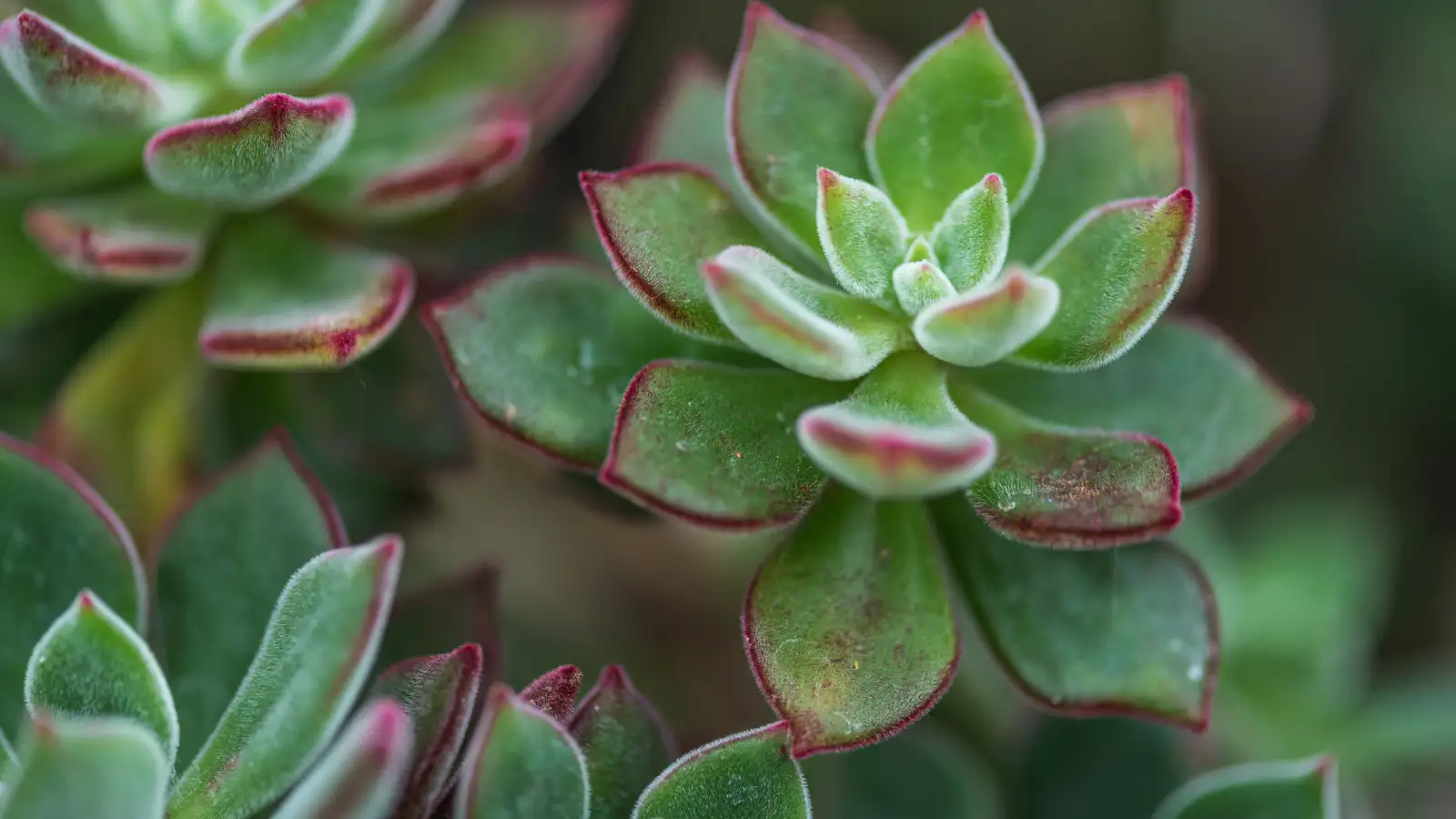
I keep a 10x jeweler's loupe clipped to the same tray as my tweezers, and the reason is not precision. It is that at arm's length, all of those things are the same gray-white smudge on a green leaf. What changes is what the smudge does when you get close to it.
Set the pot on the counter and bring a lamp around to the side instead of overhead. Side light rakes across a leaf surface and makes a raised film cast a shadow, which is the easiest way to tell whether you are looking at something sitting on the leaf or something growing out of it. Hold the pot at eye level with one hand and tilt it. If you have a phone, this is also where the macro lens earns its keep: hold the phone two or three inches from the leaf, tap the white patch to focus, and move the phone closer instead of pinching to zoom. Zoom is digital and softens exactly the detail you need.
Start with your fingertip, not a spray bottle
The first question is not what this is. It is what this does when it is touched.
Powdery mildew is dry and flour-like. Press a fingertip into it and it smears into a streak the way chalk dust does, and it comes up on your skin. It sits on the surface with no structure you can pick up. Under magnification it reads as a flat, even film with no visible edge, thinner at the margins and heavier in the middle of the patch.
Mealybugs are not a film. They are bodies. A mealybug is a segmented, oval insect covered in white wax, often with filaments fringing the sides, and it does not smear — it squashes, or it walks. What you usually find first is not the insect but the mess: cottony tufts, waxy white clusters packed into a joint, sometimes a sticky residue around them. If a white patch comes apart in strands when you drag a toothpick through it, you are not looking at a fungus.
Then there is the one almost nobody checks for, because it is not a problem at all. Many succulents — Echeveria, Dudleya, Graptopetalum, and plenty of others — produce their own powdery epicuticular wax, usually called farina or bloom. It is even, it follows the curve of the leaf, and it sits there like the dusting on a plum. It is also the one white coating your fingertip ruins. Wipe it and you leave a dark, glossy fingerprint that will not grow back on that leaf. So on a plant with obvious bloom, look before you touch.
Where the white sits tells you more than what it looks like
Location is the second filter, and for me it is the more reliable one.
Powdery mildew tends to show up first on the upper surface of the leaf and on new growth — the center of the rosette, the freshest leaves, the parts of the plant with the least air moving over them. Crowded indoor plants in winter, plants pressed against a window, plants that never catch a draft: that is mildew territory. New leaves may come in slightly distorted or curled under a heavy infection, which is a tell none of the insects give you.
Mealybugs do the opposite. They want the hidden places: the axils where the leaf meets the stem, the underside of the lowest leaves, the tight center of the rosette, along the stem, and down at the root crown where the plant meets the soil. Root mealybugs live entirely below the surface, and the only way you find them is to unpot a plant for another reason and see white cotton on the roots. If you find white fuzz in a crevice, in a joint, or under a leaf, weight the diagnosis toward insects even when it looks powdery.
Hard water leaves its own signature, and it is a shape rather than a texture: a crusty white ring at the leaf tips, along the pot rim, at the soil line, in the saucer. It is gritty rather than powdery, it does not spread across the middle of a leaf, and it reappears in the same place after the next watering. If the white is a ring or a rim, you are looking at minerals, not an organism.
Spider mite webbing is the outlier. It is not a coating at all. It is fine, irregular strands, usually tucked in the gap between the leaves and the stem, and it is almost always paired with stippled yellow damage on the upper leaf surface where the mites have been feeding. Fine webbing plus speckled, faded leaf color is a completely different picture from an even white wash.
If it is sticky, mildew is out
This one is decisive. Powdery mildew is dry. If the white substance feels tacky, or if the leaf surface around it is shiny and slightly gummy, you are looking at honeydew — the sugary waste that sap-sucking insects excrete — and honeydew comes from bugs, not from a fungus.
Honeydew also explains a second symptom people misread. Where it accumulates, a dark sooty film can grow on top of it. So a plant with white fuzz in the joints and black patches on the lower leaves is often not two diseases. It is one insect problem plus a mold feeding on insect waste. That distinction matters, because the two get handled in completely opposite directions, and one of them is not a fungus at all.
The two seconds of magnification that settle it
A hand lens at 10x, or the macro lens on your phone, answers the only question that matters: is this alive, and what shape is it?
Mildew has no legs. It reads as a film, sometimes with a faint thread structure — mycelium — if you get good light and a steady hand, and it wipes into a smear. Insect bodies are discrete: oval, segmented, fringed, sometimes with legs you can see moving under a loupe. Dried salts look like crystals, angular and glittery at the edges, willing to break apart under a fingernail instead of smearing.
Two caveats, because I have run into both. First, you can have a mix. A plant that came home from a crowded store shelf, or one that has spent a winter pressed against a cold window, can carry mealybugs and mildew at the same time, and honeydew on a leaf surface gives mildew an easier place to start. Finding one does not rule out the other. Second, early mildew is faint — a scatter of small white dots rather than a full film — and it is genuinely easy to write off as dust or farina for a week or two. If the dots are multiplying and the leaf underneath them looks duller than its neighbors, that is worth a second look under the lens.
The mistake I have made, more than once, runs in both directions: treating a bug with a fungal product because the white was white, and scrubbing a plant that was never sick because its own wax looked like a disease. Neither mistake came from knowing less. Both came from skipping three questions that cost nothing to ask. Dry or sticky. Upper leaf or hidden joint. Alive or not. That is the whole diagnosis, and it comes before anything gets sprayed, wiped, or thrown out.
Educational content only: check with a qualified horticulturist, licensed pesticide applicator, or your local extension office before acting on anything specific.

Label Rules for Powdery Mildew Fungicide on Succulents
Use sulfur, copper, or chlorothalonil on succulent powdery mildew the right way: label limits, PPE, spray timing, phytotoxicity, and rotation.