Don't Cut Every Yellow Leaf Off Your Succulent Yet
A yellow leaf comes off your succulent only after you have confirmed what turned it yellow. Soft yellow tissue does not recover, so removing it is cosmetic unless the cause — water sitting against the roots, cold damage, a leaf simply finishing its life at the bottom of the rosette — has already been corrected. And the only tissue worth cutting for propagation is firm, green, and clean at the base. Anything translucent or mushy will rot in the tray instead of rooting.
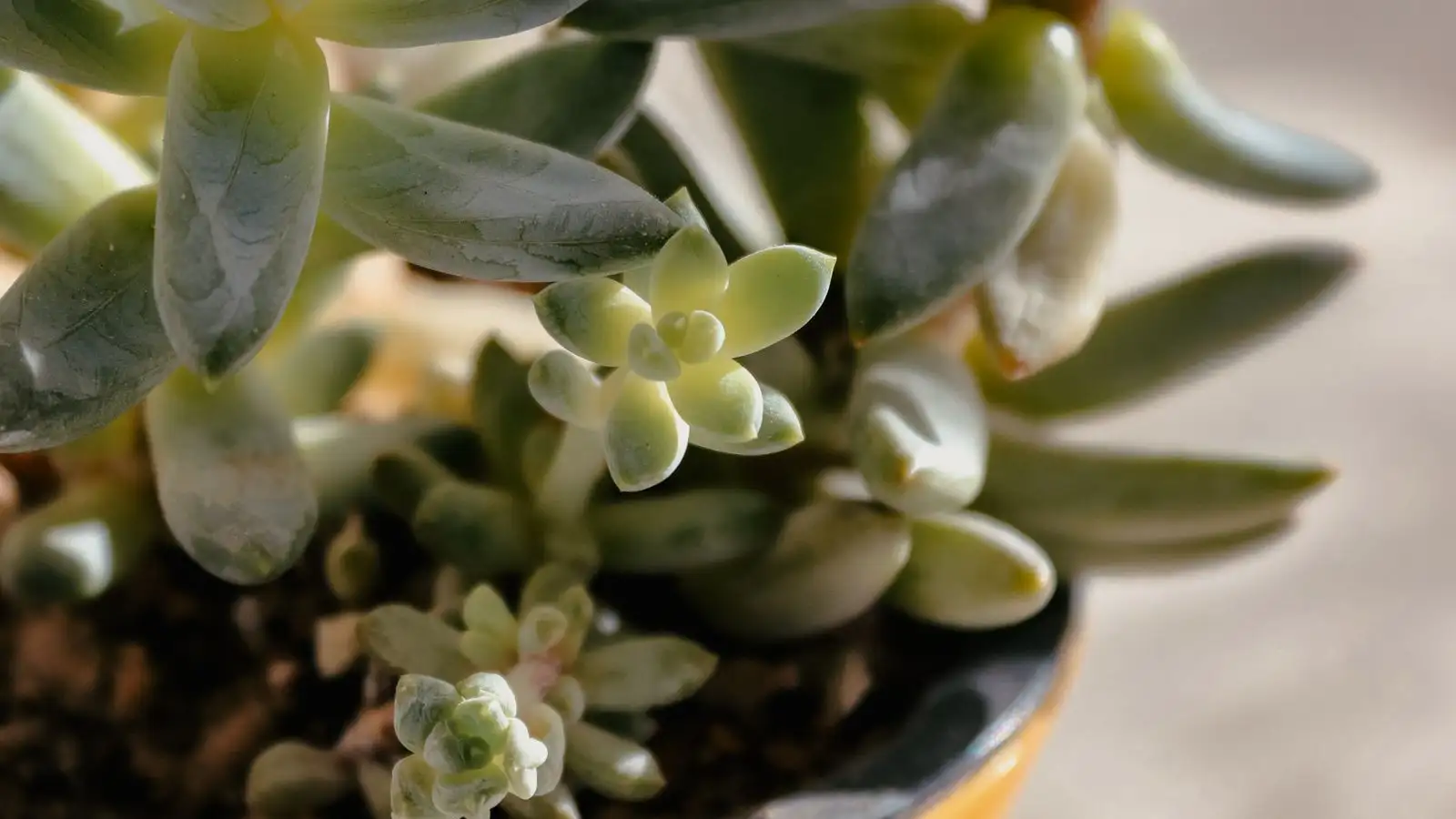
When I am standing at the counter with the plant in one hand and snips in the other, the question I am asking is not whether the leaf looks bad. It is what the stem feels like under the soil line. That order matters more than anything else in the whole process, and it is the step people skip, because the leaf is right there in front of you and the stem is buried and is not.
The check comes before the cut
I tip the pot and squeeze the stem right at the soil line with two fingers. A healthy stem is firm, closer to a green bean than anything else. A sick one gives. There is a slight softness to it, the way a piece of fruit goes soft in the bowl, and once you have felt it you do not need a second opinion.
Then I read the rest of the evidence. A single yellow leaf at the very bottom, on a plant whose stem is rock firm and whose pot is light as a cracker, is usually just age. The plant is pulling what it can out of its oldest leaf and letting it go. That is the case where pulling it off is fine, even tidy, and costs you nothing.
A yellow leaf sitting above a pot that still feels heavy, with soil that smells like a wet basement an inch down, is a different animal. So is a leaf you can see light through. That is rot, and the root system underneath it is probably already in worse shape than the leaf suggests.
I have pulled leaves off a plant in that second condition because it felt like doing something. All I did was open four wounds on a plant that was already losing and hand the rot four new doorways. It went from one yellow leaf to a collapsed rosette inside of nine days. That is the part nobody tells you: the damage from an early cut is not neutral. It is a second injury on a plant that has no reserves to spend on healing.
So now the rule runs in one direction. If the stem is soft, no leaf comes off until the stem and root zone have been dealt with. If the stem is firm and the roots smell like soil and not like a swamp, the yellow leaf is a symptom of something environmental — a wet week, a cold windowsill, a plant moved outside before the nights warmed up — and I fix that first and then wait about two weeks before touching anything. Leaves that yellowed from cold or from a wet stretch will keep dropping for a while even after the cause is gone, because that tissue is already spent. You are not watching for the yellowing to stop. You are watching the new growth in the center come in flat and firm. That is the signal that the cause is actually behind you.
The one thing I will not wait on: if the yellowing is climbing and the stem is going soft, the cause is confirmed and you are already in surgery territory. Waiting there just moves the line upward.
What actually goes in the tray
Firm green is the threshold, not "not yellow yet." If a leaf dents under a thumbnail, it goes in the trash. If you can see light through it, it is already gone. The leaves worth taking are the ones just outside the damaged area that still feel like a fresh pea pod, and the base is the whole game — I twist gently and pull, and what I want is the entire leaf plus the little pale nub where it met the stem. If the base tears and leaves a chunk behind on the stem, that leaf usually fails, and I have stopped pretending otherwise.
A leaf pulled off a plant with active rot is carrying the same organism that took the stem. That does not automatically doom it, but it does mean it does not get to share a tray or a shelf with anything healthy until you know what it does.
Drying is the step people rush
This is where most of the failures happen, and it happens in the first hour, not the first week. The cut leaves go on a plate or a paper towel in open air, out of direct sun, on a dry counter — not on soil, not on a damp saucer, not in a plastic tub with the lid cracked for humidity. In my house that is five to seven days in winter and closer to ten in a humid summer. What I am waiting for is a scab: a dry, tan or silver patch over the wound with no shine to it. If it still glistens, it is not ready, and pressing it into mix now just gives the rot a wet foothold on a leaf that has no roots to fight back with.
Do not put them in sun while they dry. A leaf with no roots cannot replace the water the sun pulls out of it, and I have cooked a whole batch that way on a bright south-facing sill in an afternoon.
Once they are callused, they rest on top of dry mix. Not pushed in, not watered, not covered, not misted. The instinct to give a cutting a little drink is the instinct that kills it, because a fresh wound plus moisture is exactly the recipe for rot.
The blade, and why it gets wiped twice
Isopropyl alcohol on a rag or a paper towel, wiped down the blade, then let it air dry for a breath before the next cut. Household rubbing alcohol at 70 percent is what I keep on the counter and it is plenty. The point is not sterility theater. The point is that a plant with rot is a plant with a pathogen in it, and that pathogen is perfectly happy to ride a blade onto the next pot on the shelf. I wipe between plants, and I wipe again between cuts on the same plant if I am cutting through anything suspect, because whatever is rotting the base can travel upward through the tissue you are slicing.
When nothing you cut will matter
If the rot has reached the crown or the growing point — the center of the rosette going dark and soft, or the stem mush all the way up to where the leaves attach — no leaf or cutting taken from that plant will save it. The leaves you are cutting look fine. That is the trick. The tissue is already colonized and just has not shown it yet. I did this on a plant whose crown was gone and pulled eight clean-looking leaves, and every one of them went soft in the tray inside a week. Nothing I did at that point was going to change the outcome, and the honest move was to accept that the plant was finished instead of using its leaves to build the illusion of a rescue.
And the limitation I will admit to: sometimes you cannot name the cause. You check the stem, you check the weight of the pot, you check where the plant has been sitting, and nothing lines up. In that case the answer is almost always to wait and watch the stem rather than cut. Cutting feels decisive. It is not. A plant that is simply too wet recovers if you stop watering it and give it light and air movement. A plant you opened up while it was still fighting has a longer road back, and sometimes no road at all.
One more thing. A leaf that roots in the tray three weeks from now tells you nothing about whether the mother plant was sick. By then it is its own plant with its own problems. Do not read it as an acquittal.
Educational content only: check with a qualified horticulturist, licensed pesticide applicator, or your local extension office before acting on anything specific.

Your Succulent Turns Yellow and Soft, So Act in This Order
Squeeze the leaf where it meets the stem, then the stem at the soil line. Here's what that ten-second test means and how fast you need to act on it.
After the First Frost, Why Succulent Leaves Go Yellow
Cold injury shows up on sky-facing outer leaves a day or two after a freeze. Check the growing point in the center before you cut, move, or water anything.
The Pest That Yellows Succulent Leaves From Below the Soil
Yellowing with no watering change usually means root mealybugs or scale feeding below the soil. How to check the root ball, read the wax, and treat.
Yellow Leaves? Check the Roots Before You Cut the Stem
Yellow leaves on a soft succulent? Unpot first. Learn what healthy vs rotted roots look like, how far to cut, and when the cut face is ready for mix.
That Soft Yellow Leaf After Watering Isn't Rot — It's Edema
Raised corky blisters on lower succulent leaves after a deep soak are edema, not rot. How to tell them apart and why airflow beats spraying.
Is a Squishy Stem Base on My Succulent Actually Rot?
Press the stem at the soil line, read the dent, and let the cut face tell you how far rot has traveled. A thumb test, a knife, and three verdicts.