Fungus Gnats or Fruit Flies? Identifying Flies on Succulents
Fungus gnats and fruit flies are told apart by three things you can see in under a minute: where the insect is standing, how it moves when you disturb it, and the shape of the adult. A fungus gnat is slender and weak-flying, with antennae longer than its head, and it lives on the soil surface and the pot rim. A fruit fly is chunky, short-antennaed, and flies straight and fast toward anything fermenting — fruit, a drain, a compost pail, a trash can. Line those three cues up and the treatment decision stops being a coin flip.
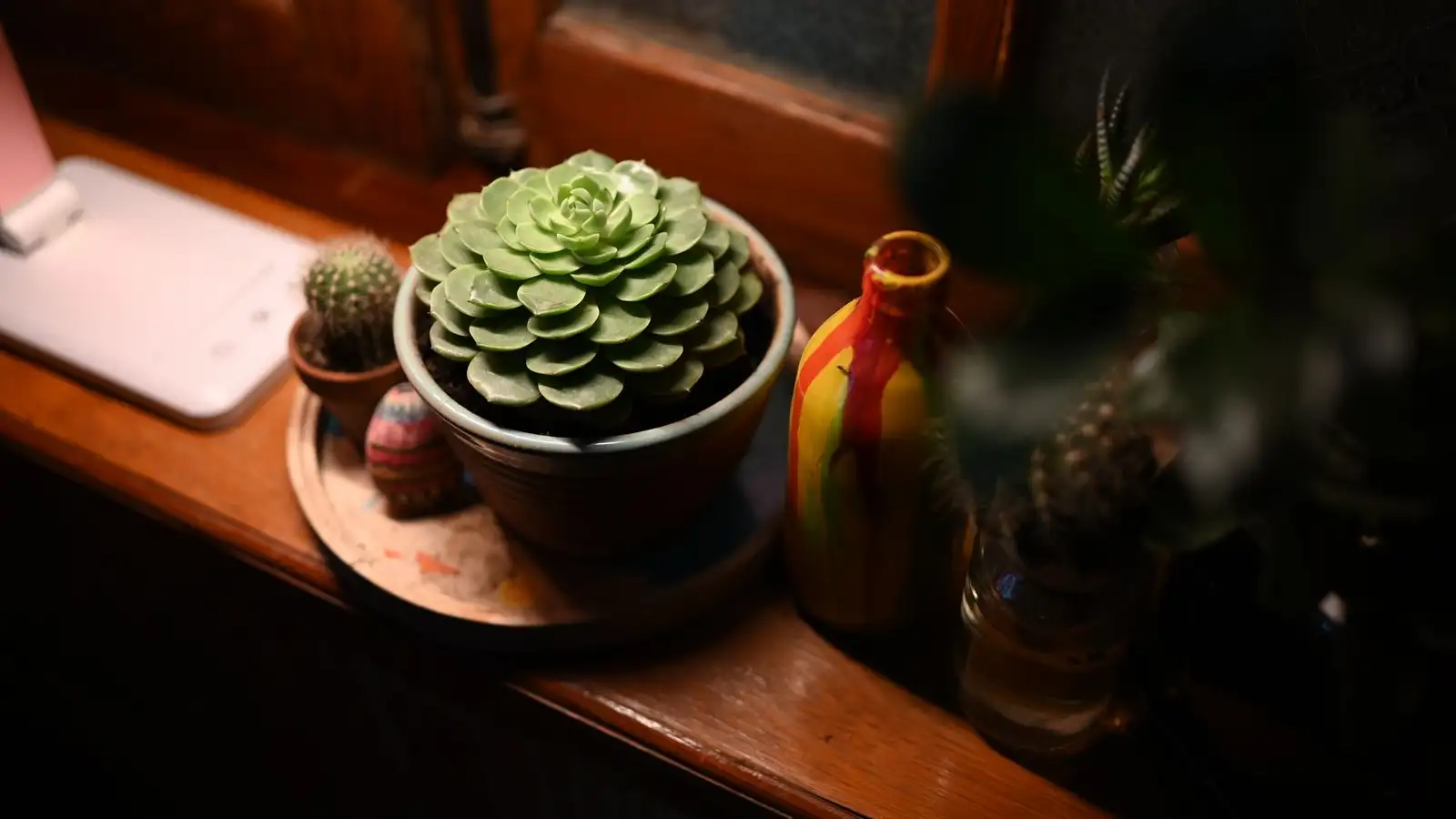
I run this with the room lights half off and a little flashlight, one pot at a time, because the whole identification falls apart the second the flies are in the air. So the first move isn't catching one. Stand still next to the shelf and count to thirty without touching anything. Almost nobody does this, and it's the reason people end up treating the wrong insect for two weeks. In those thirty seconds you'll usually see one or two of them walking around on the grit at the base of the plant — a short run, a pause, another run. Fruit flies don't do that. A fruit fly in a room doesn't walk on soil at all. It finds an edge, launches, and goes looking for sugar.
Then tap the rim of the pot with a fingernail. Not hard. You want to see what happens next, not launch everything into the ceiling.
Start with where the insect is, not what it looks like
Watch where the fly goes when you're not chasing it.
Soil surface, pot rim, saucer, the outside of the pot near a drainage hole — fungus gnat or shore fly. Both breed in wet soil, both hang around the bottom of the plant, and both will be back on that soil within a few seconds of you swatting at them.
Leaf undersides, especially on new growth, and a puff of small white things lifting off when you tilt the pot — whitefly. They feed on the underside of the leaf, not in the soil.
Leaves and flowers, with silvery streaks and black specks — thrips. They scrape the leaf surface instead of piercing it cleanly.
The air between your shelf and the kitchen, around a fruit bowl, hovering over a sink drain or a bag of potting mix left open under the counter — fruit fly, and your plant is just a landmark it happens to pass.
If they're on the soil and they're dark and fast, and they fly in a straight line across the room when you get close — shore fly. More on that one below.
How it moves is the fastest cue
Fungus gnat: fluttery, weak, short. Tap the rim and a few of them lift an inch, drift, and settle right back onto the soil or the rim. They'd rather run. Put your hand over the pot and they'll walk around it rather than fly past it.
Fruit fly: direct and quick, with a hovering zigzag around whatever it wants. Hard to swat because it commits and it's fast in a straight line.
Shore fly: similar to a fruit fly in flight, which is exactly the problem. Fast, direct, perfectly willing to leave the shelf and cross the room. Fungus gnats almost never do that in the middle of the day.
Whitefly: rises in a small cloud from the underside of a leaf, flutters, resettles within a few inches.
Thrips: barely fly at all. They flick, hop, or slide into a leaf axil. If the insect is jumping rather than flying, it isn't a fungus gnat.
The shape test, where the guessing ends
Catch one. A yellow sticky card, a strip of tape, or just a fingertip against the pot rim, then look at it through a loupe or the macro setting on your phone.
Fungus gnat: about an eighth of an inch, mosquito-thin, dark gray to black, long legs, and clear wings that extend past the tip of the abdomen. It sits with the wings lying flat and overlapping over its back, like a closed book. The antennae are beaded and clearly longer than the head, which is the easiest thing to check if you don't have magnification, and it's what separates a gnat from every small fruit fly. If you can get a clear photo of the wing, look for a vein near the front edge that forks into a Y. That fork is the gnat's signature.
Fruit fly: same general size, thick through the middle, tan to amber, with wings that are rounded and short and eyes that are usually red or dark red. The antennae are short stubs you can barely make out.
Shore fly: shiny, dark, thick-bodied, closer to a scaled-down housefly, with shorter legs and a bristlier look.
The shore fly is the one that keeps fooling people
Shore flies breed in wet soil and algae just like fungus gnats, and they turn up on the same yellow cards and the same pot rims, so most people assume it's the same problem and stop looking. The difference matters, because the stakes aren't the same.
Shore fly larvae feed on algae and decaying organic matter. They aren't chewing the fine roots of your succulent. Fungus gnat larvae do feed on fungi and fine roots in wet soil, and in a pot that never dries out, that damage stacks on top of the rot you were probably already worried about.
The practical tell is the body and the flight. Shore flies are stouter, darker, and shinier than a gnat, with a thicker abdomen and shorter legs, and up close the antennae are short. They also fly like they mean it. If the fly crosses the room in a straight line and lands on the wall, you're probably looking at a shore fly.
And it is entirely possible to have both in the same pot.
What isn't a fly but gets blamed anyway
Whiteflies and thrips get lumped in with gnats because they're all small and they all show up when a plant is stressed. Neither one breeds in soil. If you're finding the insects at the bottom of the pot, on the rim, or on the saucer, you're looking at something else.
Springtails are the other one people misread. They're tiny, they jump rather than fly, and they're usually pale or gray. They feed on decaying matter and fungi in wet soil, and a few of them are not the emergency people treat them as. But they're a signal, same as gnats, that the pot is staying wet too long.
The fuzzy ones with heart-shaped wings that hop around the kitchen sink are drain flies. They don't breed in the succulent pot at all, so if that's the fly you're seeing, your plants aren't the source.
The trap check, and why the count beats the ID
Yellow sticky cards are the confirmation step. Push one down at the edge of the pot so the card sits just above the soil, or lay one flat across the rim. Give it three or four days, then look at what's stuck.
You're checking two things. First, whether the flies are actually coming out of the soil. A card that fills up over a pot with no fruit bowl anywhere nearby confirms the pot as the source. Second, and this is the part people skip: count them, write the number on the card, and check it again in a week. If the count is falling, whatever you changed about your watering is working. If it's the same or climbing, the soil is still staying wet too long, and nothing else you do will matter much.
Cards won't tell you the species by themselves. Shore flies land on them. Stray fruit flies land on one sitting near the kitchen. That's why the shape check comes before or alongside the trap, not after.
If you want to confirm larvae in the soil, cut a slice of raw potato, press it face-down into the soil surface, and lift it after two or three days. Clear or white larvae with a black head capsule on the underside mean gnat larvae are in there. It isn't elegant, but it's a direct answer instead of an inference.
The three-step check I actually run
- Where is it? On the soil, rim, saucer, or pot — gnat or shore fly. On leaf undersides — whitefly. On the leaf surface with silver scarring — thrips. In the air near food, a drain, or a compost pail — fruit fly.
- How does it move? Weak fluttering hop-and-land — gnat. Direct, fast, crosses the room — shore fly or fruit fly. Cloud lifting off a leaf — whitefly. Flick or jump — thrips.
- What shape is it? Long beaded antennae, slender body, wings past the abdomen — fungus gnat. Short antennae, chunky body, red eyes — fruit fly. Shiny, thick, short-legged — shore fly.
If the answer comes back fungus gnat, the fly was never the real problem. The moisture was. That's the part a lot of people skip past on the way to buying something to spray.
What I've gotten wrong with this
I once spent about ten days convinced I had fruit flies, because two of them landed on a sticky card near my kitchen counter. The actual source was a tray of wet pots on the shelf behind me, sitting in a saucer of standing water, with a couple of coir plugs I'd forgotten about. The card near the kitchen was catching travelers, not residents.
The other one hurts more. I had a stretch where I kept treating a shore fly population as gnats, drenching the soil on a schedule, and the fly count went up instead of down. Wet soil feeds both of them. Nothing I was doing was wrong for gnats, but it was making the actual situation worse.
And there are limits worth naming. Phone macro can't resolve a wing vein on a moving target. A blurry photo can't either. If you've got a mixed population, the three-step check will point you in two directions at once, and both may be right — that's not a failure of the method, it's just what a wet shelf in a warm room looks like.
On a succulent shelf, a fungus gnat population is a watering problem wearing a pest costume. That's why I bother with antennae and wing veins at all. Get the ID right and leave the soil wet, and the flies are back in two weeks and you start the whole thing over.
Educational content only: check with a qualified horticulturist, licensed pesticide applicator, or your local extension office before acting on anything specific.

Safe Fungus Gnat Treatments That Won't Harm Your Succulents
Oils and soaps burn succulent leaves. Choose soil drenches, Bti, or nematodes instead, read the full label, and know when to skip treatment entirely.

Four Steps to Eliminate Fungus Gnats from Succulent Pots
Dry the top inch, trap the adults, drench with Bti, and repeat on the gnat life cycle. A four-week schedule that treats every succulent pot at once.
Hidden Root Damage Fungus Gnat Larvae Cause in Succulents
Clear, black-headed larvae in the top inch of soil chew root tips, causing yellowing, wilting, and stalled growth. Here is how to find them and read the damage.
Fungus Gnats Don't Cause Root Rot, But Here's What Does
Fungus gnats don't rot succulent roots. They signal the wet soil that does. How to tell larval damage from fungal rot and treat both problems in one move.

How Succulent Owners Can Keep Fungus Gnats Away for Good
Fungus gnats in succulents come from wet soil and unquarantined plants. A habit-by-habit prevention checklist built around drying the top inch.
The Fungus Gnat Life Cycle Stage That Keeps Them Coming Back
Eggs hatch in 3 to 6 days, larvae feed for 10 to 14, pupae rest for 4 to 6. Here's the repeat schedule that ends fungus gnats in succulent pots for good.