Is that white fuzz on your succulent powdery mildew or not?
Powdery mildew on a succulent reads as a white, flour-like film that smears when a dry fingertip drags across it, and that smear is the fastest way to separate it from everything else white on a leaf. Mealybug wax pulls away in cottony clumps and usually has an insect underneath. Hard-water crust sits at the leaf edges and tips and will not move without moisture. Edema blisters rise out of the leaf as corky bumps and do not come off at all. Get the smear right and most of the confusion is already gone.
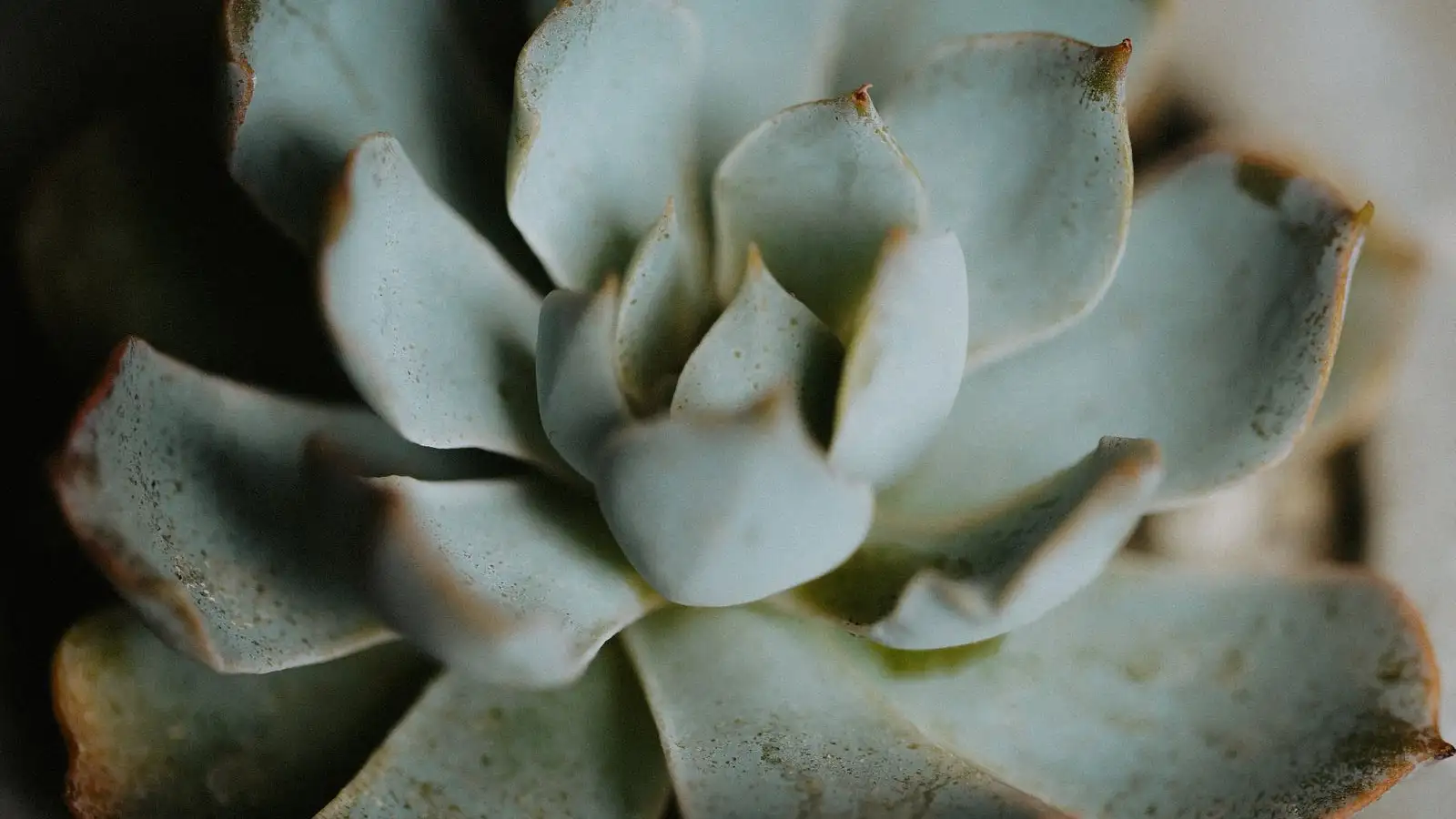
I want you standing at the bench with me, holding the pot in one hand and tilting it so the light from a window rakes across the leaf surface instead of landing flat on it. Flat light turns every white thing into the same white thing. Raking light gives you relief. You can see whether the coating sits on the skin like dust or rises out of it like a scab, and that difference alone will tell you which of these you're dealing with before you touch anything.
So tilt, then look, then touch. In that order.
Start with the smear, not the color
Drag a dry fingertip across a small patch. Not rub — drag, the way you'd wipe a smudge off a phone screen.
Powdery mildew gives. It smears into a faint greasy ghost of a stain and leaves the leaf underneath looking dull, sometimes faintly bronzed or yellowed where the patch has been sitting for a while. Come back in three to five days and the patch is there again, often slightly bigger, because what you did was move spores around, not remove the infection. That return is the second half of the test, and it's the part people skip. Anything that comes back after a clean wipe on a dry leaf is fungal until proven otherwise.
Fail the smear and you're looking at something else. I go through the candidates the way I actually check them.
Location does most of the sorting
The pattern matters as much as the texture, and the pattern is set by what the white stuff is made of.
Mealybug wax is built by an insect, so it clusters where an insect can hide. Leaf axils, the seam where a leaf meets the stem, the underside of a leaf pressed against another leaf, the growing point. If you nudge a cluster with a toothpick it comes apart into loose cotton and there's a small pale oval bug or an even smaller nymph underneath, and the leaf below the cluster feels tacky. Sticky residue means an insect. Mildew does not make honeydew. That single clue has saved me more wasted time than any other.
Hard-water crust forms where water sits and evaporates, which means leaf edges, leaf tips, and the low side of a rosette if you water from above. It's crusty — you can feel grit — and it usually makes a ring or a crescent that follows the leaf margin. A dry finger doesn't move it. A wet fingertip will, and it dissolves rather than smears, leaving nothing behind once it's gone. Mildew doesn't come off in a clean wipe; it just redistributes.
Edema is different again, because nothing is on the leaf. The leaf itself has raised a bump. Look at the undersides. Edema blisters are small, corky, and slightly domed, often in loose rows along the midline, and they feel like a callus under your thumb. They don't rub off, they don't spread to the plant next to them, and new leaves tend to come in clean once whatever imbalance caused them passes. It's a plant physiology problem, not an infection, and treating it like a fungus is the classic mistake.
Then there's sunburn, which people confuse with mildew mostly because both show up as a change on the upper leaf surface. Sunburn is dry, brown, and papery. It doesn't smear and it doesn't wipe. If the patch is white and moving, it isn't sunburn.
What a loupe actually adds
A 10x jeweler's loupe is the tool I reach for when the smear test is ambiguous. A clip-on macro lens on a phone does the same job in a pinch.
Under magnification, powdery mildew stops looking like dust and starts looking like a mat — matte, granular, and slightly fuzzy, sometimes with tiny upright chains of spores standing off the surface like a field of short bristles. Mineral crust looks completely different: sharp flakes, crystalline edges, flat rings. It does not look alive. Edema shows as a smooth dome of cork with no surface texture at all.
The loupe doesn't decide for you. It confirms what the smear and the location already suggested.
The white coating that's supposed to be there
Here's the one that trips up more people than mealybugs do. Some succulents grow their own white coating — a waxy bloom that sits on the leaf surface, heaviest on the newest leaves and on the outer leaves of a rosette. It's even. It's on every leaf. It doesn't cluster, it doesn't sit at the edges, and it doesn't care where water landed.
Rub it and you reveal clean green tissue under a shiny, fingerprint-shaped patch. That coating does not grow back on that spot. It's not a disease and there's nothing to treat — which is the problem, because the correct diagnosis is "leave it alone" and most people don't.
How you tell it from mildew: mildew is patchy. It lands on some leaves and skips others, it doesn't respect the symmetry of the plant's own coating, and on a plant that already carries a white bloom, mildew piles on top as a denser, flatter white that reads grayer than the wax around it. You can still wipe a small patch and watch for the return. The plant's own coating won't come back in a week. Mildew will.
The cases that don't sort cleanly
Mildew and hard-water crust can both be on the same plant, and they can be on the same leaf. I've seen a mildew patch sitting directly on top of a mineral ring at the leaf edge, which is probably the single reason people give up and spray the whole pot. Wipe one defined area, mark the date, and judge that area on its own. Don't wipe the entire plant to settle it.
Early mildew on a heavily bloomed plant is also genuinely hard to see, and I won't pretend otherwise. If you're not sure, isolate the plant, wait three days, and look again. Powdery mildew gets worse. Mineral crust and edema don't change. That wait-and-recheck step is the honest answer for the ambiguous ones, and it beats guessing wrong in either direction.
One last thing before you start wiping. Every smear test removes something, and on a plant with a natural wax coating, that removal is permanent on that spot. Do the test at the leaf edge where it won't matter, or on an older leaf you were going to lose anyway. Small patch, dry finger, raking light, three days. That's the whole method.
Educational content only: check with a qualified horticulturist, licensed pesticide applicator, or your local extension office before acting on anything specific.

Your succulent can survive powdery mildew if you act fast
A white flour-like patch on a succulent is powdery mildew. Confirm it in two seconds, treat it the same day, and keep it off the rest of your collection.
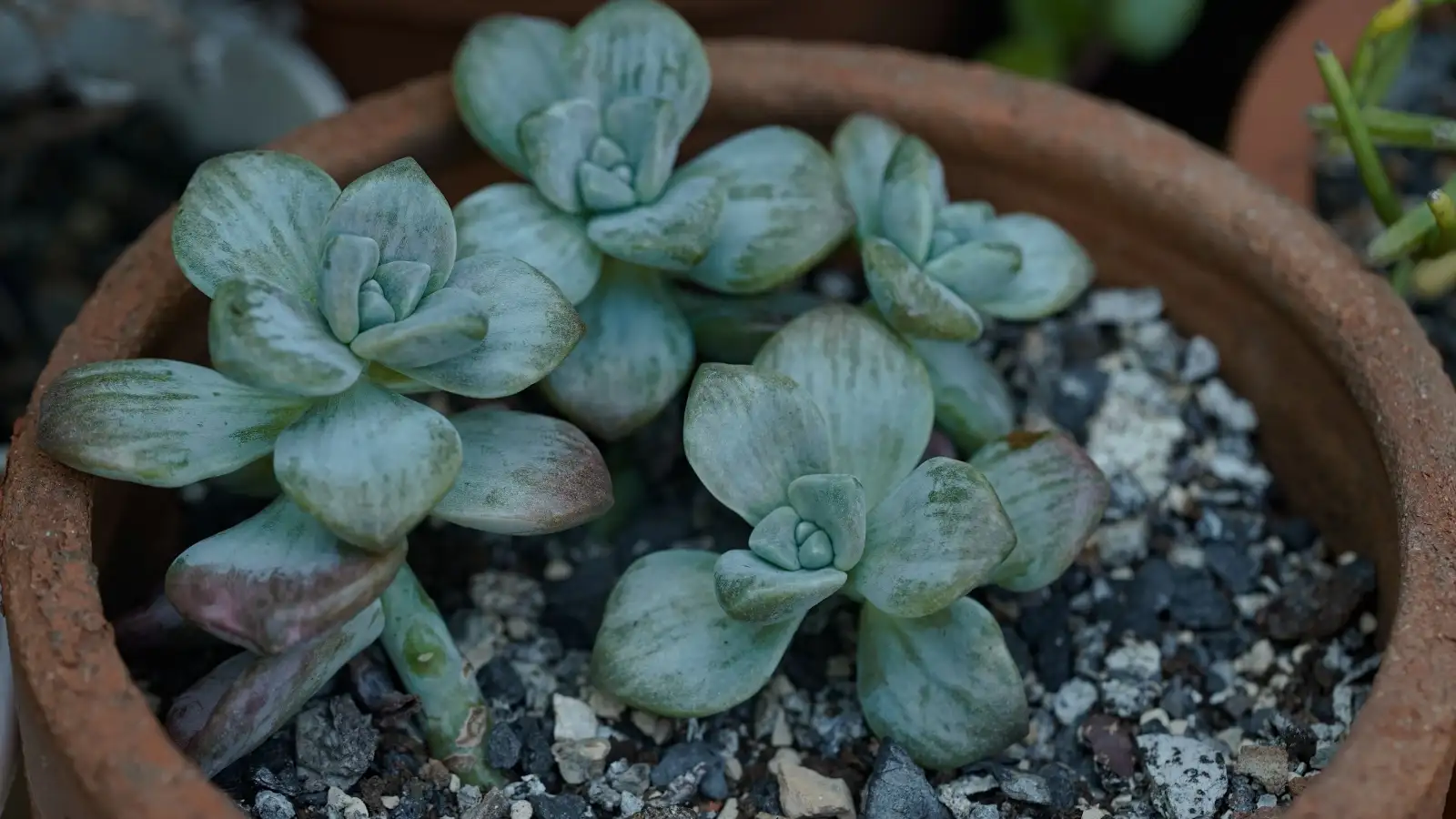
The reason your succulent's powdery mildew keeps coming back
Powdery mildew returns when the microclimate around your succulent still fits the fungus: high humidity, still air, and temperature swings. Fix the conditions.
Stop powdery mildew spreading to other succulents now
Powdery mildew spreads on air, hands, and tools. A practical quarantine and 70% alcohol hygiene protocol to keep it off the rest of your succulent shelf.
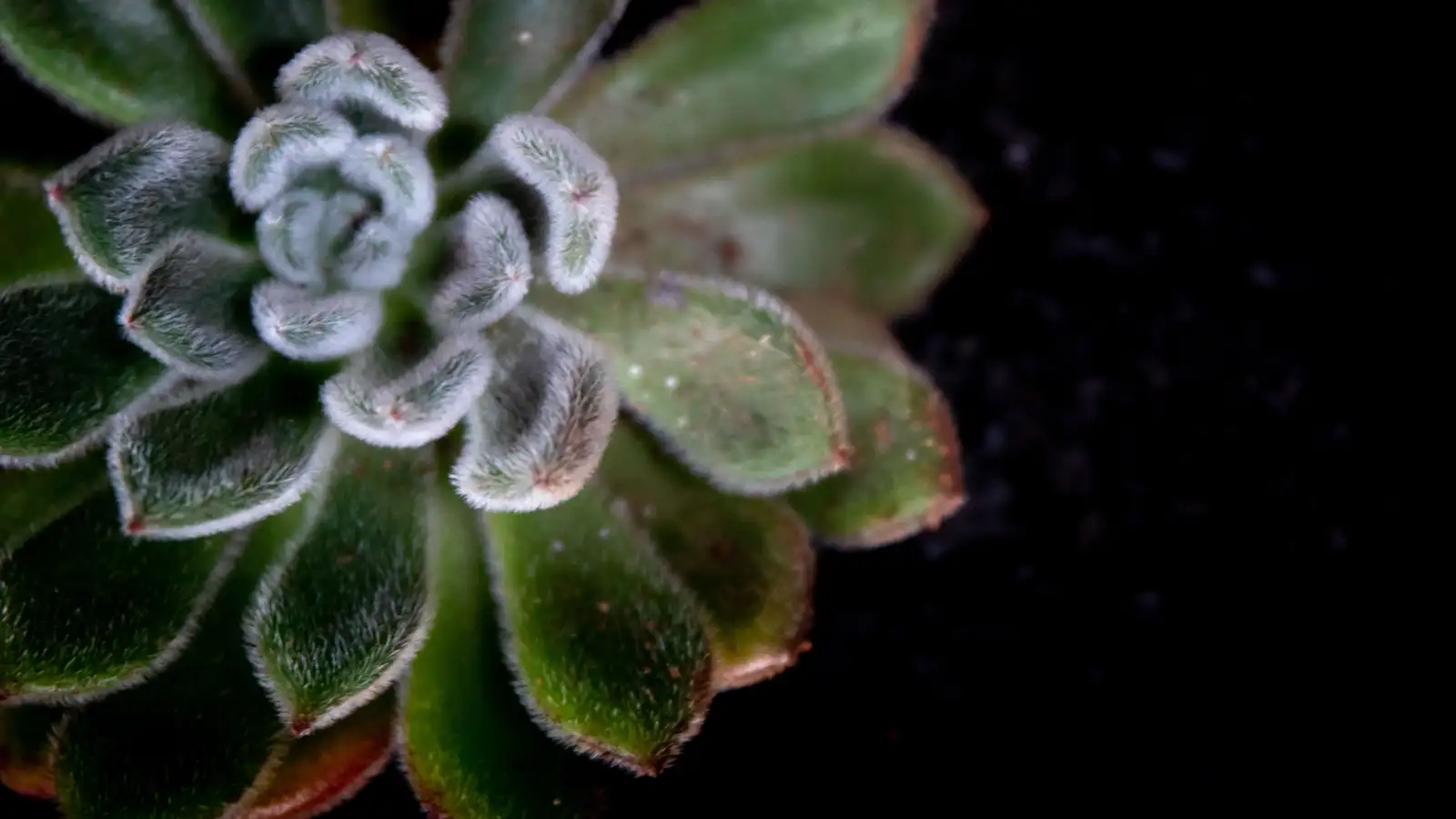
Cutting off powdery mildew leaves can make it worse
Removing powdery mildew leaves from succulents often spreads spores and opens wounds. Here's when to cut, when to leave it, and how to propagate clean leaves.

Beat powdery mildew on succulents without harsh chemicals
Isolate, strip bad leaves, dab 70% isopropyl on spots, then alternate insecticidal soap or neem oil every 7-14 days without burning the leaves.
What fungicide experts choose for powdery mildew on succulents
Powdery mildew on succulents: when sulfur, copper, or chlorothalonil is the right call, how temperature and coverage decide the outcome, and the label rules.